The Future of Self-Awareness: Why Consciousness May Be Humanity's Most Valuable Skill
Explore the future of self-awareness, consciousness, and human evolution. Discover how deeper self-knowledge, connection, and inner growth may become humanity's most valuable skills in the years ahead.
For generations, progress has been measured by technological advancement. We celebrate faster computers, smarter devices, artificial intelligence, medical breakthroughs, and the endless expansion of information. Yet as humanity moves deeper into the twenty-first century, an important question emerges:
What if the next great leap forward is not technological, but human?
As our external world becomes increasingly complex, the ability to understand ourselves may become one of the most important skills of all. In a future shaped by rapid change, uncertainty, and constant stimulation, self-awareness offers something technology cannot provide—a deeper understanding of who we are, why we think the way we do, and how we can live with greater clarity and purpose.
The Age of Information Is Becoming the Age of Self-Knowledge
We now have access to more information than at any other time in history. Answers are available instantly. Artificial intelligence can generate content, solve problems, and perform tasks that once required years of expertise.
Yet despite this abundance of information, many people feel disconnected, overwhelmed, and uncertain about their direction in life.
Information alone does not create wisdom.
The future may belong not to those who know the most, but to those who understand themselves most deeply. Self-awareness helps us distinguish between external expectations and inner truth. It allows us to make decisions that align with our values rather than simply reacting to the pressures of the world around us.
As automation handles more routine tasks, uniquely human qualities such as self-reflection, emotional intelligence, intuition, creativity, and authentic connection may become increasingly valuable.
The Return to Inner Authority
For much of human history, people have looked outside themselves for guidance. Authority was often placed in institutions, traditions, experts, or societal expectations.
While external guidance remains important, many individuals are beginning to recognize the value of developing an inner compass.
Self-awareness invites us to listen more carefully to our own experiences, patterns, emotions, and instincts. Rather than seeking constant validation from the outside world, we learn to cultivate trust in our own understanding.
This does not mean rejecting knowledge or expertise. Instead, it means integrating external information with internal wisdom.
The future may require a balance between technological intelligence and human consciousness.
Consciousness and Human Evolution
Human evolution is often viewed through a biological lens, but evolution can also occur psychologically, emotionally, and spiritually.
Throughout history, consciousness has expanded through new ways of seeing ourselves and the world. Concepts that were once considered revolutionary—such as human rights, global cooperation, and environmental responsibility—have gradually become part of our collective awareness.
Today, another shift may be underway.
More people are exploring practices that foster self-awareness, mindfulness, personal growth, and meaningful reflection. There is a growing recognition that individual transformation contributes to collective transformation.
When we become more conscious of our thoughts, beliefs, fears, and motivations, we gain the ability to respond rather than react. This shift can improve relationships, communities, workplaces, and ultimately society itself.
The Power of Connection
Despite living in an increasingly connected digital world, genuine human connection remains essential.
Connection begins with understanding ourselves. The more aware we become of our own patterns and conditioning, the more capable we are of relating authentically with others.
Future progress may not be measured solely by economic growth or technological innovation, but also by the quality of our relationships—with ourselves, with one another, and with the planet.
A more conscious society recognizes that personal wellbeing and collective wellbeing are deeply interconnected.
Why Self-Awareness Matters More Than Ever
The challenges facing humanity are complex. Rapid technological change, environmental concerns, social transformation, and information overload require more than technical solutions.
They require conscious human beings.
Self-awareness helps us:
- Make aligned decisions.
- Navigate uncertainty with greater confidence.
- Develop emotional resilience.
- Strengthen relationships.
- Recognize unconscious patterns.
- Live with greater authenticity and purpose.
These are not merely personal benefits. They are skills that support healthier communities and a more sustainable future.
Looking Ahead
The future is not something that simply happens to us. It is something we actively participate in creating.
Technology will undoubtedly continue to transform the world, but the most important question may not be what technology becomes.
The question may be what we become.
As humanity moves forward, self-awareness offers a pathway toward greater wisdom, compassion, and conscious evolution. The future may belong not only to those who innovate externally, but also to those who cultivate a deeper understanding of themselves.
In a world that increasingly values speed, self-awareness reminds us of the importance of presence.
In a world overflowing with information, it reminds us of the value of wisdom.
And in a future filled with possibilities, it may become one of humanity's most valuable skills.
Continue the Journey
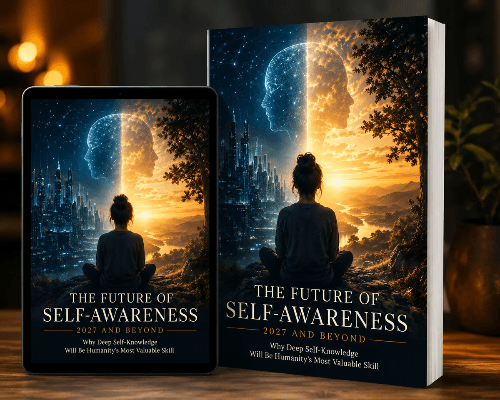
If this article resonated with you, my book explores these ideas in greater depth, examining why self-awareness, consciousness, and personal growth may become humanity's most valuable skills in the years ahead.
The Future of Self-Awareness: 2027 and Beyond
Available on Amazon as Kindle e-book and Paperback